The Three Ages of Redemption
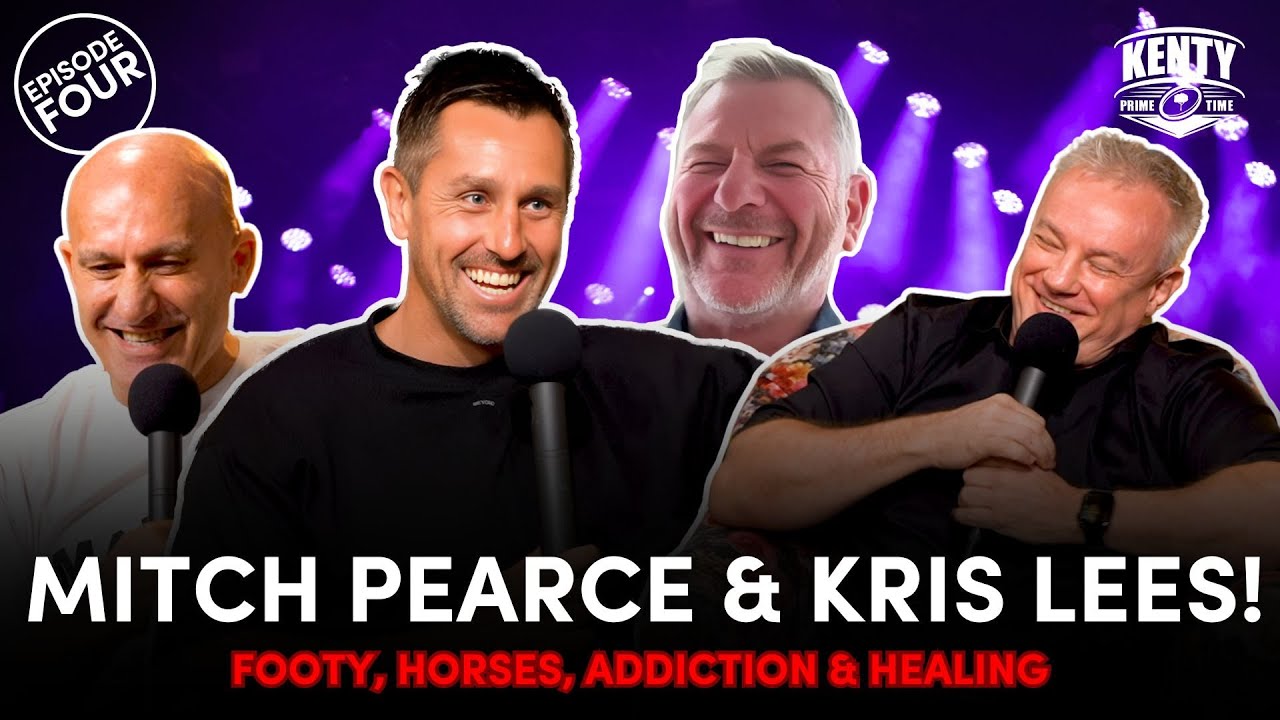
In this episode of Kenty Prime Time, Kenty sits down with former NRL halfback Mitchell Pearce and leading trainer Kris Lees for a wide-ranging discussion that moves from the technical decline of halfback craft to deeply personal reinvention. It is a conversation about playmaking, pressure, consequence and, ultimately, redemption.
The Halfback Crisis: Why Aren’t We Producing Playmakers?
Mitchell Pearce offers a granular assessment of the modern halfback, arguing that contemporary junior systems are eroding instinct in favour of rigid structure. He suggests that even 14-year-olds are now drilled in “block-for-block” attacking shapes rather than encouraged to play what is in front of them. In his view, the over-coaching of structure implants fear—young players become risk-averse, anxious about error, and disconnected from the improvisational DNA that once defined the great No.7s.
Drawing on lessons from Andrew “Joey” Johns and Matthew Johns, Pearce outlines the tactical triggers that shaped his own development: identifying starting points by targeting specific defenders, “telling lies” with eyes and body language to manipulate defensive lines, and maintaining relentless, loud communication to control tempo. Johnny Elias expands the critique, arguing that physically smaller but skilful juniors are being squeezed out of the pathway by early physical mismatches. Faced with oversized opponents in adolescent competitions, many drift towards football codes such as soccer where the physical disparity is less pronounced.
Mitchell Pearce: The Reboot and Life After Alcohol
In a candid segment, Pearce reflects on his decision to stop drinking two-and-a-half years ago and the personal reckoning that preceded it. He describes his twenties as cyclical—periods of sobriety and elite performance during the season, followed by destructive off-season lapses that perpetuated a pattern of self-sabotage. The breakthrough came after what he calls a three-day binge overseas with Todd Carney. Looking at himself afterwards, he recognised a growing disconnect between the public persona and the person he believed himself to be.
That moment became the catalyst for Reboot, a seven-step holistic framework Pearce has co-founded with Carney. The programme centres on forensic self-assessment, realignment of goals and the installation of disciplined daily habits designed to create sustainable behavioural change. For Pearce, the project is less about abstinence alone and more about restoring authenticity and agency.
The PNG Expansion: A Tax-Free Advantage?
The panel also interrogates the financial ramifications of a prospective Papua New Guinea expansion side. Kent raises the possibility that players based in Port Moresby could operate in a tax-free or preferential tax environment, effectively increasing their net income relative to Sydney-based counterparts. In a salary-cap system predicated on competitive parity, he argues, such a structural disparity could distort recruitment dynamics.
Elias counters that inducement is precisely the point. Relocating elite talent to PNG will require material incentives, whether financial, infrastructural or lifestyle-based. In his assessment, without a compelling lure, the expansion risks stagnation before it begins.
The Golden Slipper: Kris Lees and Ravalina
Premier Newcastle trainer Kris Lees joins the programme to discuss his unbeaten colt Ravalina ahead of the Golden Slipper. He draws parallels between conditioning two-year-old thoroughbreds and developing teenage footballers: both are temperamentally volatile, prone to rapid form fluctuations and highly sensitive to environmental stimulus.
Lees reveals that Ravalina’s performance curve shifted markedly following the application of blinkers—a gear adjustment designed to narrow peripheral vision and sharpen focus. The change, he explains, prevented the colt’s concentration from wandering mid-race and unlocked measurable improvement in closing speed and race discipline.
The Dylan Brown Crossover?
The discussion circles back to rugby league, with Elias reiterating his provocative suggestion that the Parramatta Eels should move Dylan Brown to Newcastle immediately as a salary-cap recalibration strategy. In his estimation, without Mitchell Moses the Eels’ campaign is effectively compromised, making asset management a rational play. Pearce rejects that calculus, arguing that a first-year head coach such as Jason Ryles cannot afford to concede competitive intent after only two rounds. To do so, he suggests, would undermine culture before it has been properly established.
Watch the episode on Fanatics TV.